New Year's Eve 2006
The Time Traveler's WifeNew Year's Eve 2006 is at once a family celebration and Henry’s unannounced farewell. On December 31, Henry, Clare, and their eight-year-old daughter Alba gather the people important to their lives, but Henry knows that he will not remain with them through the new year. His departure turns the familiar rituals of a party—welcoming relatives, sharing the countdown, raising a glass—into the last moments Clare and Henry can spend together in the present.
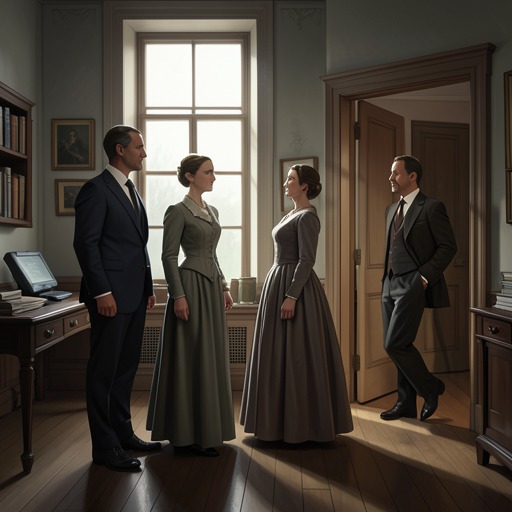
The party and its guests
Clare initiates the celebration, although Henry is initially reluctant. She admits that she has maneuvered him into agreeing by bringing up the party in front of Alba, whose excitement he cannot bear to disappoint. Before the guests arrive, Henry sits at the kitchen table showing Alba how to cut flowers from carrots and radishes. The domestic scene sets the party’s tone: its preparations are not grand, but they are shaped by the small shared practices of a family.
The guest list gathers several generations and overlapping parts of the couple’s life. Henry’s father and Kimy arrive, followed by relatives, friends, colleagues, and Clare’s artistic circle. Among those invited are Alicia, Gomez and Charisse, Philip, Mark and Sharon with their children, Gram, Ben, Helen, Ruth, Kendrick and Nancy with their children, and Celia Attley, whom Clare specifically insists should be included. Alba races to greet her grandfather and Kimy, then takes Kimy to see the Christmas tree. The bustle of arrivals makes visible the community Henry and Clare have built around their household.
The gathering also acquires the meaning of a farewell before Clare knows why. As he welcomes his father, Henry thinks that his life will soon flash before his eyes. He mentally inventories the people present and those who cannot be there: among the absent are his mother, Lucille, and Ingrid. His fear is directed not only toward his own approaching death but toward the prospect of leaving Clare among the guests after the party has ended.
The concealed farewell
Henry has invited everyone who matters to him, but he has not told Clare what he anticipates. When she discovers the truth, she asks why he let her invite all those people without warning her. Henry explains that he does not want her to be alone afterward and that he wanted to say goodbye to everyone. The party’s purpose therefore divides sharply between the spouses: Clare has arranged a celebration for their family and friends, while Henry has understood it as a last gathering.
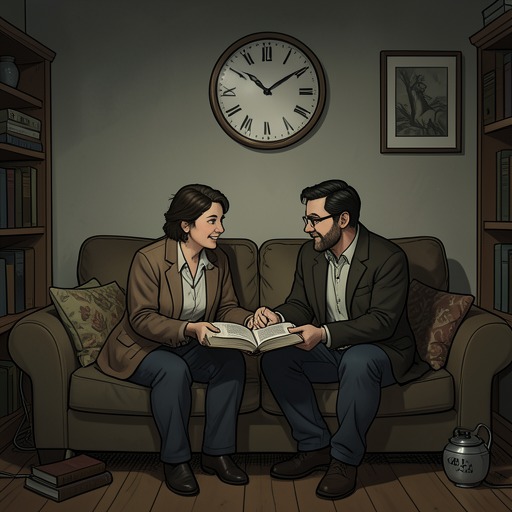
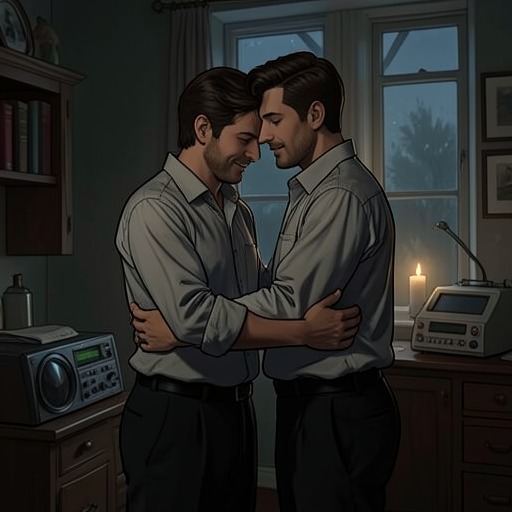
Clare and Henry withdraw from the company to the porch, where they lie together on the divan as the snow falls. The contrast between the party inside and their quiet retreat gives the farewell its shape: the guests continue celebrating, while the couple faces the knowledge that Henry’s presence cannot be secured by Clare’s embrace. Their conversation turns to the time remaining, and Henry acknowledges his fear. Clare asks him to kiss her; the moment is an intimate, deliberate goodbye rather than a resolution that can stop his departure.
Midnight and its aftermath
As midnight approaches, Henry is feverish, and Clare holds him close, struggling to accept that his familiar physical presence may vanish. The new year arrives while they are together on the porch. Then Henry disappears, leaving Clare alone beneath the blanket. Inside, the record stops, Gomez begins the countdown, the guests call out the final numbers together, and a champagne cork pops. The party crosses into the new year; Clare does not cross it with Henry.
The guests’ celebration continues before anyone realizes that Henry and Clare are missing. Outside, firecrackers go off in the street. Clare waits on the porch, alone after the kiss and the disappearance. The ordinary New Year’s ritual thus becomes an emblem of the couple’s unequal experience of time: the calendar advances for the people in the house, while Henry’s absence turns the new year into the beginning of Clare’s waiting.
Narrative significance
The scene draws together domestic happiness and foreknowledge without making them equivalent. The food decorations Henry teaches Alba to make, the arrival of family and friends, and the communal countdown all affirm the life the couple has assembled; Henry’s private understanding of the evening makes each of those details part of his farewell. His wish that Clare not be alone explains why he gathers the guests, but it cannot spare her the immediate solitude of his disappearance.
The novel’s dated, alternating perspectives make the moment part of a larger pattern in which Henry and Clare do not share the same knowledge of an event at the same time. Here, that asymmetry is concentrated within a single evening: Henry knows the party is his last hurrah, while Clare experiences its meaning as a sudden revelation. The chapter’s movement from celebration to waiting leaves the farewell unresolved in the present, even as a later dated scene returns Henry to Clare in her old age.